Layered spatial model
Twelve-tap early reflections feed a four-diffuser input stage and two cross-coupled decay tanks.
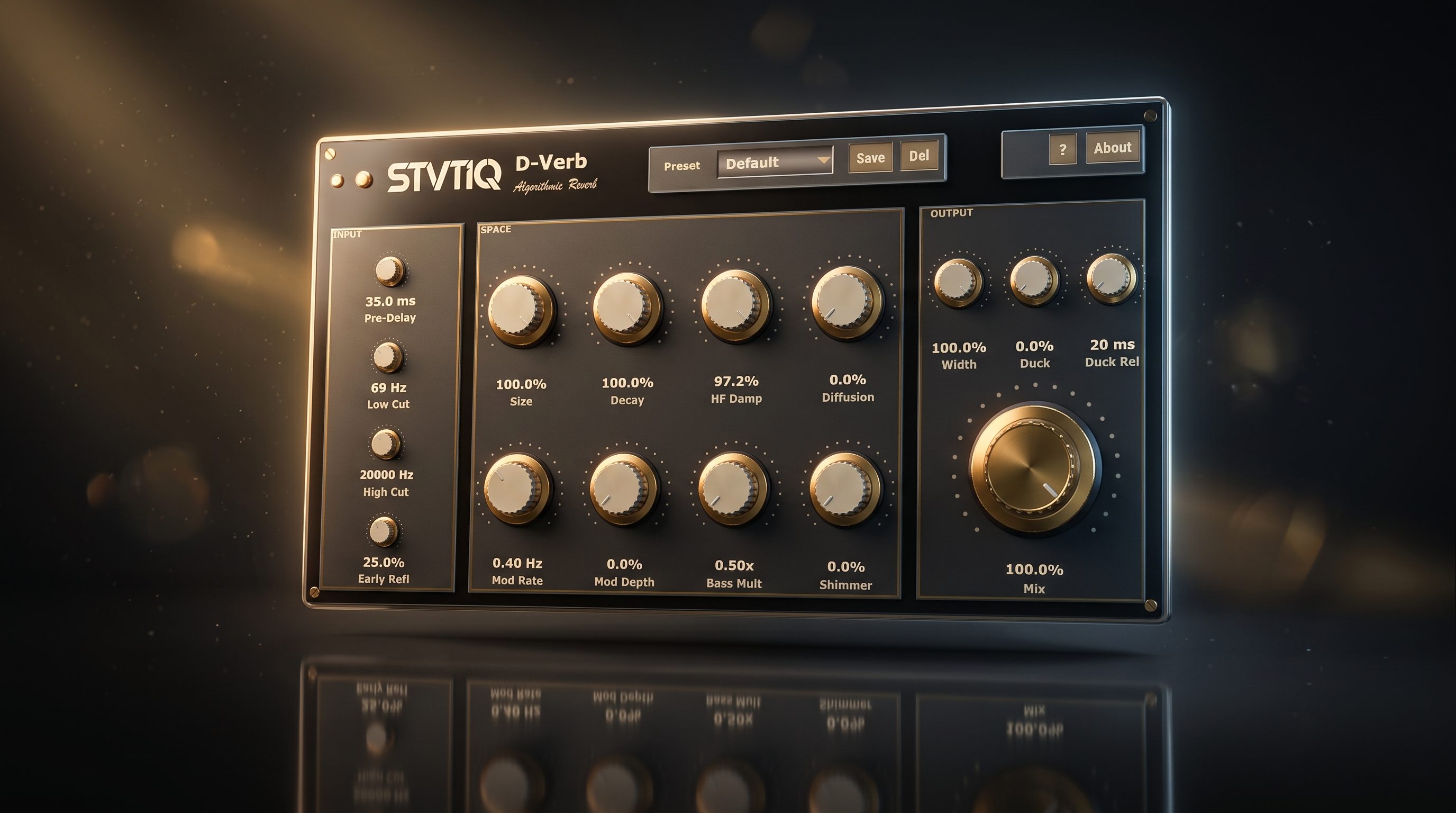
STVTIQ / Plugin 01 / Algorithmic reverb
A stereo space that can stay behind the source or bloom into a sound of its own — with independent early reflections, modulated diffusion, ducking and shimmer.
Why D-Verb
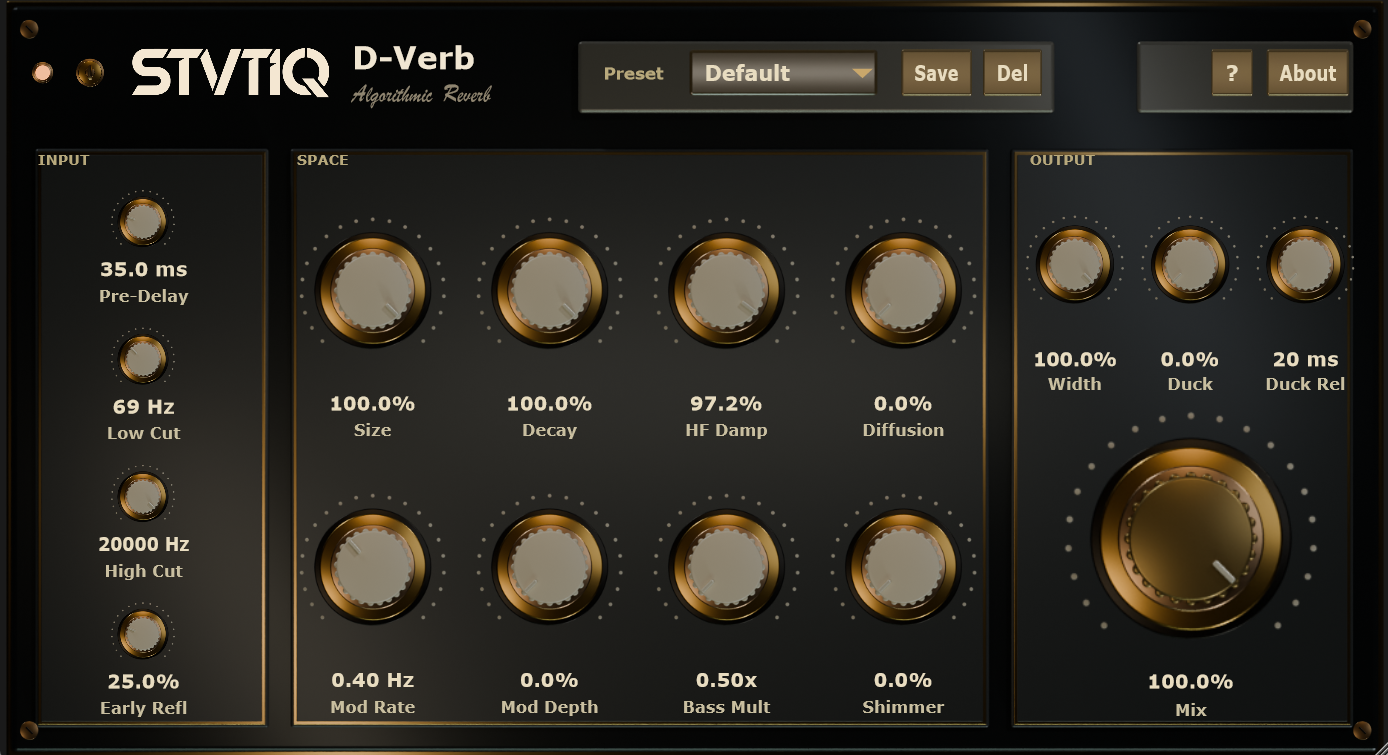
D-Verb separates the first sense of a room from its evolving tail, giving you direct control over clarity, scale and movement.
Twelve-tap early reflections feed a four-diffuser input stage and two cross-coupled decay tanks.
Animate the decay diffusers, extend low-frequency sustain and introduce a safety-scaled octave-up shimmer.
Wet-only width, source-aware ducking and dedicated release control keep long spaces intelligible.
Sound demo
Hear D-Verb across dry/wet comparisons and practical musical examples in the official sound demonstration.
Signal path
The diffuse stage intentionally downmixes to mono before generating a synthetic stereo field from multiple network taps.
Starting points
All factory presets load 100% wet for send/return use. Lower Mix when inserting D-Verb directly on a track.
Focused vocal and instrument spaces with enough pre-delay to preserve definition.
A short, narrower ambience led by early reflections — useful for drums and close sources.
A large, dark response with long decay and a restrained shimmer component.
Textural presets for pads, sound design and more obvious spatial movement.
Technical details
Every audio control and bypass state is visible to the host and stored with the project.
| Audio | Stereo input / stereo output · 32-bit floating point |
|---|---|
| Processing | 2x oversampled diffuse Space stage; early reflections at host sample rate |
| Core controls | Pre-delay, filtering, early reflections, size, decay, damping, diffusion, modulation, bass sustain, shimmer, width, ducking and mix |
| Interface | Resizable from 440×240 to 1760×960 at a fixed aspect ratio |
| Platform | Windows x64 · macOS |
| Formats | VST3 · Audio Unit (AU) |
| License | Proprietary freeware — free to use |
Free and full-featured. If it earns a place in your sessions, voluntary support helps fund updates and future STVTIQ tools.